
- HOME
- ABOUT US
-
-
ABOUT US
This is a living forum where individuals, families, and communities across generations come together to exchange wisdom, insight, and experiential learning, with the common goal of preserving integrity, heritage, and vision for the future. This is a convening circle, a place where the wisdom of experience and the passion of loving and living for others thrive together and where discourse serves as an avenue of growth.
-
-
-
-
- WRITINGS
- BLOG
- LIBRARY
- FAMILIES
- COMMUNITY
- CULTURE
-
-
VISUAL ARTS
-
PERFORMING ARTS
-
-
- RESOURCES
- CONTACT




Book Review
Book Review
Richard Rohr's Falling Upward and the Apophatic Tradition: Same Goal, Different Means
by Lewis Burgess
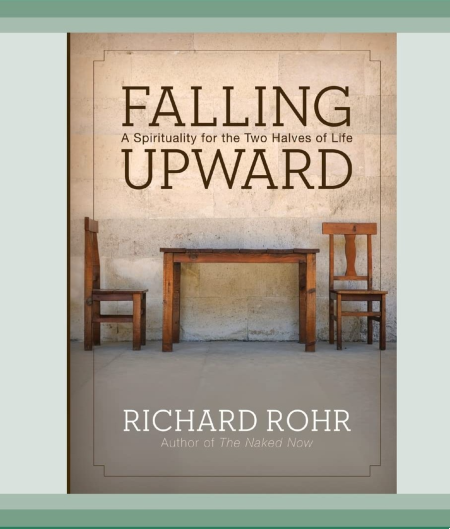
Richard Rohr’s Falling Upward is a book that speaks to those who sense a hollowness in outward success, whose carefully constructed identities or personas no longer hold the same weight or function as they once did. Rohr offers a language for thinking and talking about this transition, which becomes a descent into a spiritual depth that embraces paradox and uncertainty over self-determined linear progress and achievement in the world. In contrast, there is another path, ancient and austere that can complement Rohr’s presentation: the apophatic tradition. Rooted in the earliest centuries of Christian mysticism, it calls not for building or refining the self, the container we imaginatively construct and fill, but for letting it go entirely. These two approaches, though distinct in their means, converge on the same mystery: union with God.
Rohr’s Two Halves of Life
Rohr’s Falling Upward proposes that human life unfolds in two halves, not strictly chronological but psychological and spiritual. In the first half, we construct a “container” for the self—a framework of identity, security, and social belonging. This phase is essential and not to be discarded but to be lived fully. But as Rohr writes, “Far too many people just keep doing repair work on the container itself and never ‘throw their nets into the deep’ (John 21:6) to bring in the huge catch that awaits them” (p. 65). The ego that seeks security, structure, achievement, and meaning, often through career, relationships, or status, cannot clearly realize that there is a second task beyond container construction and repair.
But at some point along the way, through failure, loss, betrayal, or the quiet erosion of human aging, the container buckles and cracks. The ego’s strategies falter, and the soul begins to long for something beyond self-definition and self-esteem. For Rohr, this is the second half of life, where growth comes not through building but through emptying, not through control but through surrender. Rohr draws on Jungian psychology, particularly the concept of the shadow and individuation, to describe this shift from the “false self” to the “true self.” His Christian mysticism, rooted in Franciscan spirituality, sees the cross not as punishment but as a pattern of descent leading to transformation. He also weaves in non-dual awareness, inspired by Eastern traditions like Zen, to point toward a union with God that transcends separation.
Rohr’s approach is a balm for those navigating a culture obsessed with material and psychological progress and success. He does not rush the reader but honors the messiness of the journey while acknowledging that grace can disrupt our plans at any moment. Falling Upward is a companion-like text and guide map that offers clarity and comfort to those facing a spiritual transition or personal reckoning due to disruptive circumstances.
The Apophatic Path: Unknowing and Surrender
The apophatic tradition, by contrast, offers no map. Emerging in early Christian mysticism and shaped by Neoplatonic thought of Plotinus and Proclus, this path—known as the via negativa or “negative way”—invites the soul to encounter God through silence and unknowing.1 This approach is found in texts like Pseudo-Dionysius’s Mystical Theology (5th–6th century), The Cloud of Unknowing (14th century), and St. John of the Cross’s Ascent of Mount Carmel and Dark Night of the Soul (16th century). The apophatic tradition teaches that God transcends all human concepts. As the anonymous author of The Cloud of Unknowing writes, “By love he can be gotten and holden, but by thought never” (p. 32). The way to God lies not in clearer definitions but in letting go of all definitions, even sacred ones.
Unlike Rohr’s developmental model, the apophatic path does not speak of stages or halves. It does not ask the soul to interpret its experiences or to and construct, refine, and repair itself but to release them entirely. Union with God is not a destination reached after healing or growth but is available now in the stillness of surrender. This can feel austere, yet it carries a tender reassurance: nothing needs to be added, for God is already present. The ego’s focus on, attachment to, or obsession with its images, stories, wants, desires, and spiritual ambitions are the only barriers to union.
Yet, the apophatic way has its shadows. Its emphasis on unknowing can risk becoming a form of spiritual bypassing, where psychological wounds are ignored under the guise or pretence of transcendence. St. John of the Cross, for instance, acknowledges the “dark night” as a painful process of confronting attachments, and this suggests that the apophatic path does not entirely dismiss interior work. Even the pursuit of “not knowing” can subtly become an ego-driven achievement and evolve into a new way for the ego to once again assert control.
Complementary Paths, Shared Mystery
Rohr’s model and the apophatic tradition are not opposed and they often meet in lived experience. Historically, apophatic mystics saw their path as complementing the cataphatic (word, symbol, and image-based) tradition. Pseudo-Dionysius paired his affirmative Divine Names with the negations of Mystical Theology, while John of the Cross wove vivid imagery with apophatic silence. Rohr, too, integrates both, using psychological insight to name the patterns that trap us while pointing toward the non-dual mystery of God.
Still, there is a subtle risk in holding either framework too tightly. Rohr’s emphasis on psychological integration and wholeness and life’s two halves can inadvertently suggest that union with God is reserved for those who have navigated enough trials or achieved a certain maturity. The ego, in striving to become an imagined whole, can become entangled in its own web of making and becoming. The apophatic tradition counters this, reminding us that no figurative wholeness is required. As The Cloud of Unknowing advises, “For as it is said before, that the substance of this work is nought else but a naked intent directed unto God…” (p. 57). Grace slips through the cracks in our containers when we are most broken, most lost, and requiring only our consent to rest in the mystery.
Even so, spiritual experience rarely follows neat categories. The psychological and mystical intertwine in unpredictable ways. A moment of apophatic silence may reveal wounds that demand attention; a psychological breakthrough may open into a mystical encounter. The soul dances between knowing and unknowing, structure and surrender, not in linear progress but in a rhythm moving with the gentle ebb and flow of surrender and grace.
Holding Both Together
To hold Rohr’s wisdom alongside apophatic silence is not only possible but also wise and nurturing for the modern contemplative. Rohr guides us to the threshold, naming the traps of the ego and the patterns of spiritual immaturity. His framework, grounded in psychological insight and cultural accessibility, helps us make sense of life’s sometimes complex transitions. The apophatic tradition opens our grasping hands and invites us to release even the ambition that seeks God. It helps us to realize that seeking itself is a response to grace, and the surrender is a beginning and not an end.
Consider a seeker who, after a season of loss, turns to Rohr’s Falling Upward and finds language for their unraveling and fragmenting identity. They begin to see their pain as a doorway to the second half of life. Later, in a moment of quiet prayer, they encounter the apophatic call to let go of all narratives, even the story of their spiritual journey. In this interplay, they find not a perfected self but a surrendered one, not a soul with answers but one willing to be held in the embrace of the mystery.
What remains is not a self-made whole, but a self undone. Not a knowledge that grasps, but a compassion that rests. This is the shared goal of Rohr’s path and the apophatic way to reach oneness through different means. The paths may differ, the language may shift, but the end is always the same: a stillness beyond silence, a union beyond words, a God who is never absent.
Notes
1 Via negativa is a theological and philosophical approach that seeks to understand ultimate reality—especially God—by describing what it is not, rather than affirming what it is. Plotinus was a 3rd-century philosopher who founded Neoplatonism, teaching that all reality emanates from a transcendent, ineffable One. Proclus was a 5th-century Neoplatonist who elaborated Plotinus’s system with intricate metaphysical hierarchies, including divine henads and structured levels of reality.
References
Anonymous. The Cloud of Unknowing. CCEL, 2012.
Pseudo-Dionysius. Pseudo-Dionysius: The Complete Works. Translated by Colm Luibheid and Paul Rorem, The Classics of Western Spirituality Paulist Press, 1987. (Mystical Theology, pp. 133–141; Divine Names, pp. 47-132).
Rohr, Richard. Falling Upward: A Spirituality for the Two Halves of Life. Jossey-Bass, 2011.
St. John of the Cross. Ascent of Mount Carmel. Translated by E. Allison Peers, Image Books, 1958.
St. John of the Cross. Dark Night of the Soul. Translated by E. Allison Peers, Image Books, 1959.